
Working Towards the Fuhrer
The Genesis of the Final Solution

By Kevin Slovinsky
February 26, 2025
In the spring quarter of my freshman year (2019) at the University of California Davis, I took a history course on the Holocaust taught by Prof. David Biale. It was an incredibly depressing class set in an incredibly depressing concrete classroom in a brutalist labyrinth that students lovingly called “The Death Star.” The course’s impact on my mental well-being was only exaggerated by the other history course I took that semester, Prof. Greg Downes’ course on slavery and the Civil War. (Thankfully, this was also the quarter I took, and nearly failed, my tractor driving class…that was lovely).
Unfortunately, Prof. Biale passed away this past July. When I recieved notice of his death, I briefly lamented my time in his class and then, frankly, didn’t think much of it. Having only take the one course with him, I didn’t know the man very well. I thought briefly, in a non-serious way, about the course when I taught a course on war and memory (which had a unit on the Holocaust) at the University of Kentucky. I tried to recall the sources he had us read and the lessons he taught about how regular people get caught up in horrific acts. I had completely forgotten, however, was the concept of “working towards the fuhrer.” Frankly, by time I took the course on the Holocaust, nineteen-year old Kevin thought he pretty much knew it all. I had seen dozens of documentaries and read far too many books on the Holocaust and far too early an age. The librarian at my elementary school banned me from checking out any more Holocaust books in the third grade, the same year I read Boy in the Striped Pajamas Recently and Milkweed. But, “working towards the fuhrer” was a completely new concept to me and it had terrifying implications. I think it’s safe to say that, when prompted, a majority of people think of the Holocaust as an operation directed by Hitler himself. The Holocaust was so horrifying, so sickening, that it had to have come strictly from the deranged meth-addicted brain of Adolf Hitler and executed by people who either believed in his vision for the world or by soldiers sworn to following orders. What Prof. Biale taught me in the Death Star was that the thousands of crimes that are now collectively known as the Holocaust were concieved of and perpetrated by people who saught to please Hitler. They made assumptions about what Hitler wanted and they worked towards making that a reality. Of course, much of the Holocaust was driven by Hitler’s direct orders, particularly as it relates to the construction of infrastructure. But, that does not take away from the fact that people, from the highest rung of Nazi officers to the lowliest soldiers, prepared for and perpetrated heinous acts that were out-of-step with Hitler’s official positions because they assumed that was what he really wanted. The notions of ‘working towards the fuhrer’ forces us to re-consider the Holocaust as a decentralized phenonemon, planned and carried out by thousands of people all looking to please Hitler and advance their own careers.
Although I had forgotten about this concept and consequently missed the opportunity to teach my own students about how people created the Holocaust by ‘working towards the fuhrer,’ I cannot stop thinking about it now. I hope my intention with publishing this old essay is obvious and doesn’t need to be spelled out. Google searches for the term “Nazi” exploded in mid-January 2025.
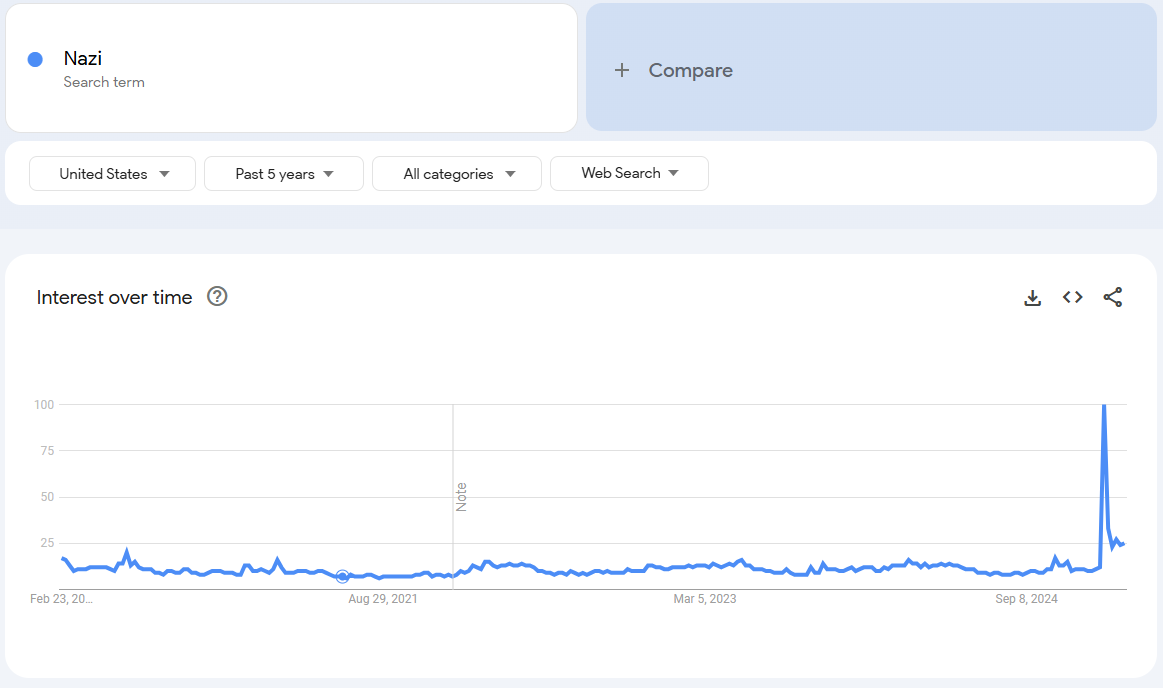
Comparisons are quick and easy to make. Comparisons should be made, especially if they awaken people to the fascist elements within our current political ecosystem. However, lessons also need to be learned and one of the many lessons from the Holocaust is that a lack of directive from an authoritarian leader creates space for individual interpretation of intent. There is only so much that one person can do, no matter how powerful they are. What scares me is the many people who will act, without directive, in competititon with one another to get the attention of their leader. By feverishly working to please Hitler, equipped only with assumptions of what would please him based on his rhetoric, sycophant Germans effectively became mini-Hitlers.
I am publishing this essay without significant modifications and without additional sources/citations for two reasons. First, I think it reflects how good Prof. Biale was at giving students a maneageble yet diverse set of sources to piece together. The sources used for this essay included primary sources, a monorgraph, a memoir, lectures, and a film adaptation of the Wansee Conference. Second, it is an honest reflection of how a nineteen-year old might think and write about the Holocaust. I am biased but I think it’s pretty good and a sign that you, reader, should consider talking about fascism and anti-fascism with everybody when given the opportunity.
Working Towards the Fuhrer: The Genesis of the Final Solution
Spring 2019
The early stages of ‘the final solution’ was a culmination of decisions made by Nazi leaders who persistently worked towards fulfilling their perception of Adolf Hitler’s goals while adapting to the ebbs and flows of the war. For this reason (and because of issues of historical documentation) it is impossible for historians to accurately pinpoint the moment in which the Nazis decided to commit genocide against Europe’s Jewish population. That being said, it is possible to create a time range from the formation of the Nazis’ concept of genocide to the solidification of those concepts as Nazi doctrine. While Hitler’s dedication to the wartime extermination of Europe’s Jews remained unclear until December of 1941, a number of Nazi leaders, particularly Schutzstaffel (SS) officials, had made the decision to prepare for what they entitled ‘the final solution’ as early as July 1941.
In order to estimate the period in which Nazi officials started thinking within the realm of what we would characterize as genocide, the term ‘genocide’ must be defined. Raphael Lemkin coined the term “genocide” during the war in response to the ongoing extermination of Europe’s Jews. After the war, the newly formed United Nations codified genocide as a crime and defined it as:
Killing members of the group; Causing serious bodily or mental harm to members of the group; Deliberately inflicting on the group conditions of life calculated to bring about its physical destruction in whole or in part; Imposing measures intended to prevent births within the group; Forcibly transferring children of the group to another group1 with the intent to destroy part of, or the whole of an ethnic, religious, or national group.
This definition is careful to include both the Nazis’ use of both passive (intentionally creating conditions that bring about death and destruction) and active (killing or causing bodily harm). This is partly because the UN defined the term with the Holocaust in mind and partly because it was made flexible enough to encompass the concepts of the Holocaust as the Nazis adapted them according to external and wartime events. Within the scope of this paper, I am strictly referring to active genocide. The Nazis had begun the process of passive genocide against the Jews the moment they forced Polish Jews into the deadly conditions of the ghettos.
While it is certainly debatable whether or not the Nazis had committed to the concept of genocide by the summer of 1941, it is clear that they had not done so before then. Hitler’s 1925 book Mein Kampf employed the violent anti-semitic language that Victor Klemperer claimed to have harshened German culture.2 However, as Mark Rosenmann argued in “The Villa, the Lake, the Meeting: Wannsee and the Final Solution,” Hitler’s repeated comparison between Jews and bacilli and parasites was largely rhetorical at that time. While Hitler was considering solutions to what Nazis termed, ‘the Jewish problem,’ those solutions were deportation and concentration.3
Even in 1939, when Hitler found himself in a two-front war against Poland, France, and England, his violent speech did not directly correlate with his policies on Jews.4 While Hitler prophesied in 1939 that a second world war would result in the “the annihilation of the Jewish race in Europe,” he vocally promoted plans of deportation to Madagascar or Siberia5 until October of 1941.6 Hitler’s early approach to ‘annihilation’ was to brutalize Europe's Jews and compel them to embark on a mass exodus out of Europe. The reasoning behind Hitler’s forced exodus strategy lies in his pre-Operation Barbarossa focus on providing lebensraum (living space) for Aryans7, destroying Jews’ place in German society, and preserving the Aryan race, none of which required the wartime extermination of Jews. This is made evident with Heydrich’s 1939 instructions to the Einsatzgruppen to create ghettos in Poland and Judenrats to govern the ghetto and facilitate the forced labor of Jews.8 The fact that the Nazis put effort into creating institutions like the Judenrat reveals that ghettos were designed for the long term concentration of Jews as a stage before deportation. Records show that external factors, particularly America’s decision to shoot at Axis ships in American waters at sight and extend the Lend-Lease system to the USSR910, opened Hitler to consider plans of extermination by October 1941. However, only by December 1941, with the opening of the first extermination camp at Chelmno, does it become absolutely clear that Hitler had, in one way or another, approved of the proposed ‘final solution.’11
While Hitler’s confirmation of the ‘final solution’ could have happened at any time between July and December 1941, top Nazi officials decided to initiate the process towards the full extermination of Europe’s Jewish population in July 1941. In June 1941, Hitler launched Operation Barbarossa, an ambitious invasion of the Soviet Union that plummeted both nations into a war of annihilation.12 Despite Hitler’s inclination to carry out the final solution after the war, the brutality of the eastern front motivated ReichsFuhrer-SS Heinrich Himmler to envisage a genocide enshrouded in ‘the fog of war.’13 In July 1941, Himmler began considering poison gas as a way to optimize the extermination process while minimizing the effect on German morale.14 In the same month, Friedrich Suhr of the Reich Main Security Office was appointed ‘Official for the Final Solution of the European Jewish Question,.’15 That means that in July 1941, Himmler conceived the concepts of active genocide and developed it into an operation requiring a bureaucratic office.
After Himmler’s June decision, SS officials began taking the next step towards developing methods of extermination. On July 31st, Reichsmarschall Hermann Göring authorized Heydrich to host a cross-departmental meeting to devise a plan for the ‘final solution.’ What the ‘final solution’ meant in July is unknown, however, given that Himmler had been making administrative preparations for extermination, it was very possibly a circumlocution for active genocide. The proposed meeting took place in January of 1942 at a villa in Wannsee and solidified the concepts of ‘the final solution’ as fully functioning Nazi doctrine. Seeing as the meeting took place a month after Chelmno began operation, it is clear that Hitler authorized the meeting. However, the meeting mostly just expanded operations that existed prior to Hitler’s explicit authorization to include the state bureaucracy.16 The role of the Wannsee Conference as merely the bureaucratization of a genocide that had been ongoing since July 1941 reveals that the period between Himmler’s decision and the conference was one of experimentation. The SS was laying down the groundwork for industrialized genocide and through tests, was discovering the optimal methods for committing genocide17. Seeing as Hitler’s authorization for Himmler’s extermination plan became clear only a month before the meeting, the majority of this murderous experimentation took place before Hitler authorized the wartime extermination of Europe’s Jews.
The fact that preparations were being made for active genocide while Hitler continuously promoted eastward deportations begs the question, how much authority over Jewish related operations did Hitler have? Seeing as it was a totalitarian government and anti-semitism served as a core of Hitler’s ideology, he had ultimate authority over all operations conducted by the German government. In line with fascist doctrine, Hitler’s power was absolute and above all else. So much so that his subordinates ‘worked towards the Fuhrer’ meaning that they personally (and often in contention with each other) endeavored to fulfill the perceived desires of Hitler.
It is through this conceptualization of ‘working towards the Fuhrer’ that allowed the political structure of Nazi Germany to allow Himmler to conduct preparations for the ‘final solution’ in July 1941 while Hitler continued to support methods of deportation. While Himmler, Göring, and Heydrich may have been operating outside of Hitler’s authorization, they continuously empowered each other to conduct operations that were recognized as ‘working towards the Fuhrer.’18 For example, it was Göring’s Ermächtigung (authorization), not Hitler’s, that Heydrich used to legitimize his authority in conducting the Wannsee Conference.19 Furthermore, General Hans-Joachim Böhme, inspired by Hitler’s promotion of the false concept of an organized ‘World Jewry,’ held a reservoir of able-bodied Jews as hostages and killed one hundred for each German soldier killed.20 He did so not under the order of Hitler, but in his own capacity to work towards the creation of Hitler’s ideal world. While Hitler may have thought it impossible to conduct active genocide and a two-front war simultaneously, Himmler, Göring, and Heydrich and other SS officials sought to carry out his 1939 prophecy and demonstrate their own capabilities. This means that by January 1942, the SS did one of two things. They either convinced Hitler to commit to conducting ‘the final solution’ during wartime because it was already active or, began operation of ‘the final solution’ in preparation for when Hitler would make the final decision, something they believed would inevitably come as a result of external factors. Either way, the SS had decided to and begun the extermination of Europe’s Jews before Hitler resolved that the ‘final solution’ could be done during wartime.
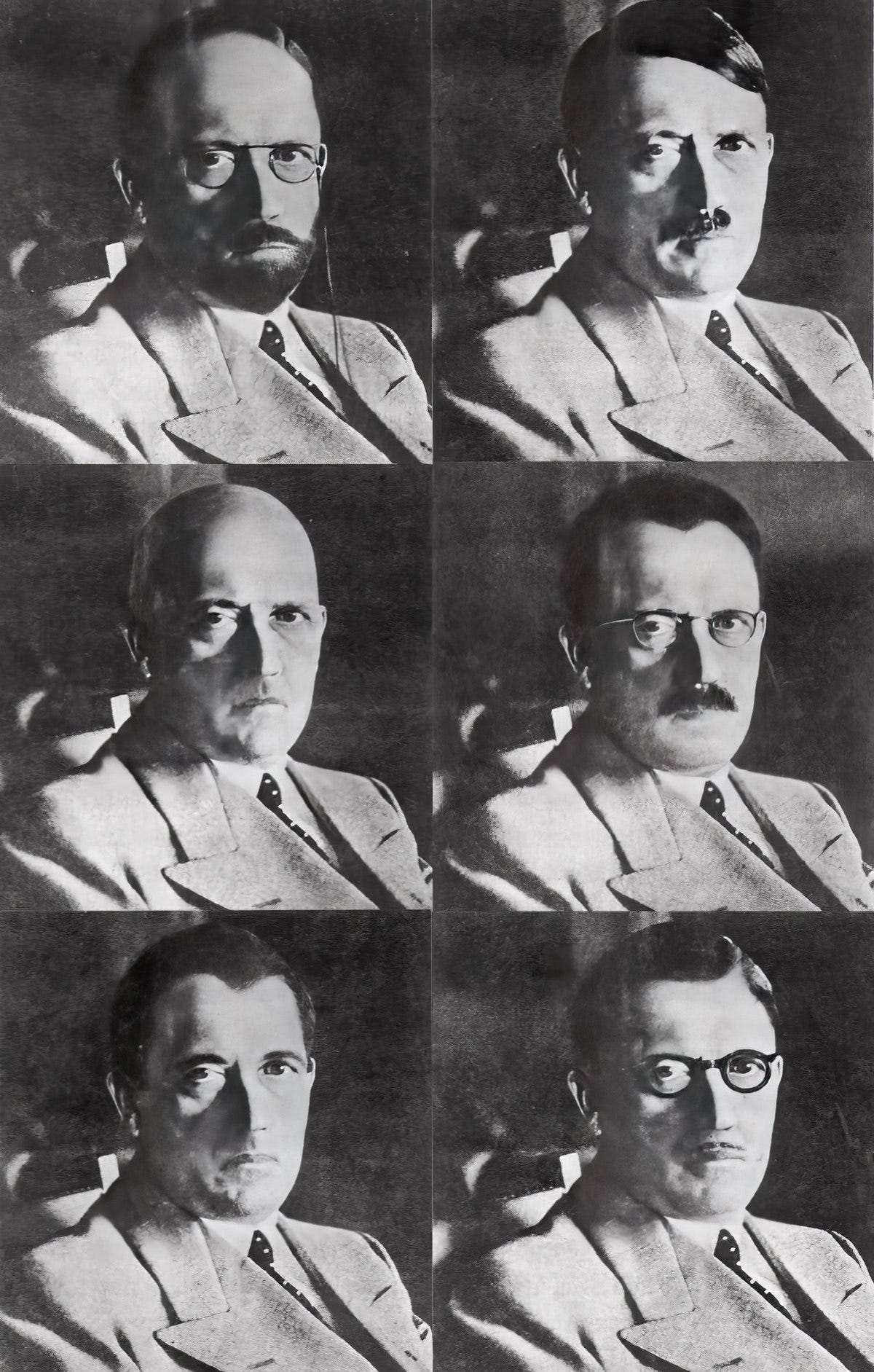
The fact is that issues of documentation make it impossible for historians to accurately pinpoint when exactly the Nazis decided to commit genocide against the Jews of Europe. However, by determining that Hitler’s violent language towards Jews did not correlate with his short term preference for deportation; by recognizing that Hitler continued to support deportation even when faced with a two-front war in 1939 and a bitter eastern front in June 1941; and by understanding that while the Nazi government was strictly totalitarian, its members pursued a practice of ‘working towards the Fuhrer,’ it is clear that the best estimate of when the decision to commit genocide against the Jews of Europe was made in July of 1941. It was during this month that Himmler, Görring, and Heydrich committed to working towards Hitler’s dream of a Jew-free Europe despite Hitler’s own belief that such an operation would be impossible during war. In an effort to prove Hitler wrong and demonstrate their own and their nation’s potential, they launched a campaign of active genocide that exterminated six million Jews.
Endnotes
1. "United Nations Office on Genocide Prevention and the Responsibility to Protect." United Nations. Accessed May 20, 2019. https://www.un.org/en/genocideprevention/genocide.shtml.
2. Klemperer, Victor, and Martin Brady. Language of the Third Reich: LTI - Lingua Tertii Imperii; a Philologists Notebook. London: Bloomsbury, 2013.
3. Biale, David. "Hitler and the Nazi Seizure of Power." Lecture, SSHH 1100, Davis, April 12, 2019.
4. Roseman, Mark. The Villa, the Lake, the Meeting: Wannsee and the Final Solution. London: Penguin Press, 2003. 35
5. Biale, David. "Life and Death in the Polish Ghetto." Lecture, SSHH 1100, Davis, May 2, 2019.
6. Roseman 42
7. The Wannsee Conference. Directed by Heinz Schirk. Youtube.com. May 29, 2014. Accessed May 16, 2019.
8. "Jewish Question in the Occupied Territory." Reinhard Heydrich to Chiefs of All Einsatzgruppen of the Secret Police. September 21, 1939. In Yadvashem.org. Accessed May 23, 2019. https://www.yadvashem.org/odot_pdf/Microsoft Word - 1984.pdf.
9. Rosenman 51
10. The direct involvement of the USSR and the indirect involvement of the US in the war brought the world closer to fulfilling Hitler’s 1939 prophecy that another world war would result in the destruction of World Jewry
11. Rosenman argues that Hitler decision was made by September because that is when he ordered the deportation of German Jews eastward, however, Hitler’s support of deportation in comments made to the governor of Poland and Croatian Marshal contradicts such certainty over Hitler’s thought process.
12. The Nazi hatred for communists and Slavs, combined with the high stakes of the war, made the war on the eastern front particularly brutal towards civilians.
13. The Wannsee Conference.
14. Rosenman 34
15. Rosenman 37
16. This broad categorization includes Party officials, the Reich Chancellery, the Foreign Office, and the Ministry for the East and General Province (as seen in the film “The Wannsee Conference”).
17. Evidenced by the gas truck tests in Minsk in September (Rosenman 42) and Böhme’s massacres (see page 6)
18. Biale, David. "Anti-Jewish Boycott to the Nuremberg Laws." Lecture, SSHH 1100, Davis, April 18, 2019.
19. The Wannsee Conference.
20. Rosenman 43-44